Letters
Graffiti Alphabet Drills: A-Z Practice for Better Letter Flow
Practice the graffiti alphabet A-Z with four-letter drills, spacing checks, and word tests that help your letters stay clean together, not just alone.
Published Feb 28, 2026 · Updated Apr 1, 2026 · 11 min read · By SprayShift Editorial

Quick Answer
Practice the graffiti alphabet four letters at a time, not all 26 at once. Use /graffiti-letters to choose your next letter, then run three controlled passes here so your letters stay readable in real words, not just as isolated shapes.
Who This Is For
Beginners to intermediate creators whose graffiti alphabet still looks like 26 unrelated letters and who want a routine that fixes structure before effects.
Table of Contents
- Use the hub for the full map, then use this post for drills
- Choose four drill letters that expose your weak spots
- Train letter families, then make them survive a real word
- Spacing and flow rules that keep words readable
- Common beginner traps and fast fixes
- What a bad drill session actually looks like
- When this style is wrong for your goal
- What to do next (10-minute drill)
- A weekly loop that keeps you from starting over every session
- Self-scoring rubric for A-Z consistency
Use the hub for the full map, then use this post for drills
If you want the full graffiti alphabet map, start on /graffiti-letters. That page is the broad owner for A-Z navigation, individual letter pages, and your first decision about which letter to practice next.
This post does a different job: it gives you a repeatable drill routine once you already know which letters you want to train. Treat it like a practice sheet, not like the all-in-one alphabet destination.
Most weak A-Z sets fail because each letter is designed in isolation. You can feel it right away: the A looks stiff, the S looks overcooked, and the R looks like it came from a different crew entirely. Lock one base system first: stroke thickness, corner behavior, slant, and negative space.
A veteran would tell you the boring truth here: clean ugly letters are more useful than stylish broken ones. If the skeleton is weak, no arrow, flare, or chrome fill is going to save the sheet.
- Choose your target letters from /graffiti-letters before you start drilling
- Pick one base skeleton style: block, rounded, or hybrid
- Lock one stroke-thickness range (for example, 10-14% of letter height)
- Keep one corner rule and one default side-bearing gap
Choose four drill letters that expose your weak spots
Do not start with all 26 letters in one sitting. Pick four letters that force you to solve different problems: one curve, one bar letter, one diagonal, and one branch or leg transition.
A practical beginner set is C, E, A, and R. C tells you whether your openings breathe, E tells you whether you can keep bars organized, A exposes bad diagonal balance, and R shows whether your transitions hold together under pressure.
A lot of people start with S because it looks fun. That usually backfires. If your straight bars and diagonals are still shaky, S will only hide the problem under extra motion.
The same goes for K and Z. They can make you feel advanced for five minutes, then punish you the second you try to build a readable word around them.
- Pick one curved letter such as C or O to test openings and counters.
- Pick one bar letter such as E or H to test vertical rhythm.
- Pick one diagonal letter such as A or M to test angle control.
- Pick one branch letter such as R or K to test transitions.
- Reuse those proportions before you expand into a full word or wider alphabet pass.
Train letter families, then make them survive a real word
Train by letter family instead of requesting the whole graffiti alphabet in one shot. Similar geometry produces cleaner outputs and faster corrections, and it also makes it obvious what is actually broken.
After each run, write one sentence about what failed. Keep it blunt. "The E bars are drifting." "The C opening is choking." "The A leans harder than the rest." Small feedback loops improve your second pass much faster than big random prompt changes.
If a family looks good in isolation, test it in a short word immediately. A clean C means very little if CLOUD still feels stitched together. That is the moment many beginners finally notice the real problem: the letters were decent alone, but they never belonged to the same word.
If a word falls apart, go back to the hub, open one letter page, and compare your weak areas against the worked examples there before you generate again.
| Letter family | Prompt focus | Why it works |
|---|---|---|
| Straight stems (E, F, H, I, L, T) | Uppercase graffiti alphabet sheet, clean block structure, even stroke weight, high contrast background | Stabilizes baseline and vertical rhythm before complex forms |
| Round forms (C, G, O, Q, S) | Rounded graffiti letters, thick outline, controlled inner counters, no background clutter | Builds consistent curve tension and open counters |
| Diagonal forms (A, K, M, N, V, W, X, Y, Z) | Angular graffiti alphabet, balanced diagonals, readable joins, minimal effects | Prevents diagonal collapse and keeps symmetry usable |
| Leg and branch forms (B, D, P, R) | Graffiti letters with clear bowl-to-stem transitions, medium side spacing | Improves branch control and readability in words like BARS or DRIP |
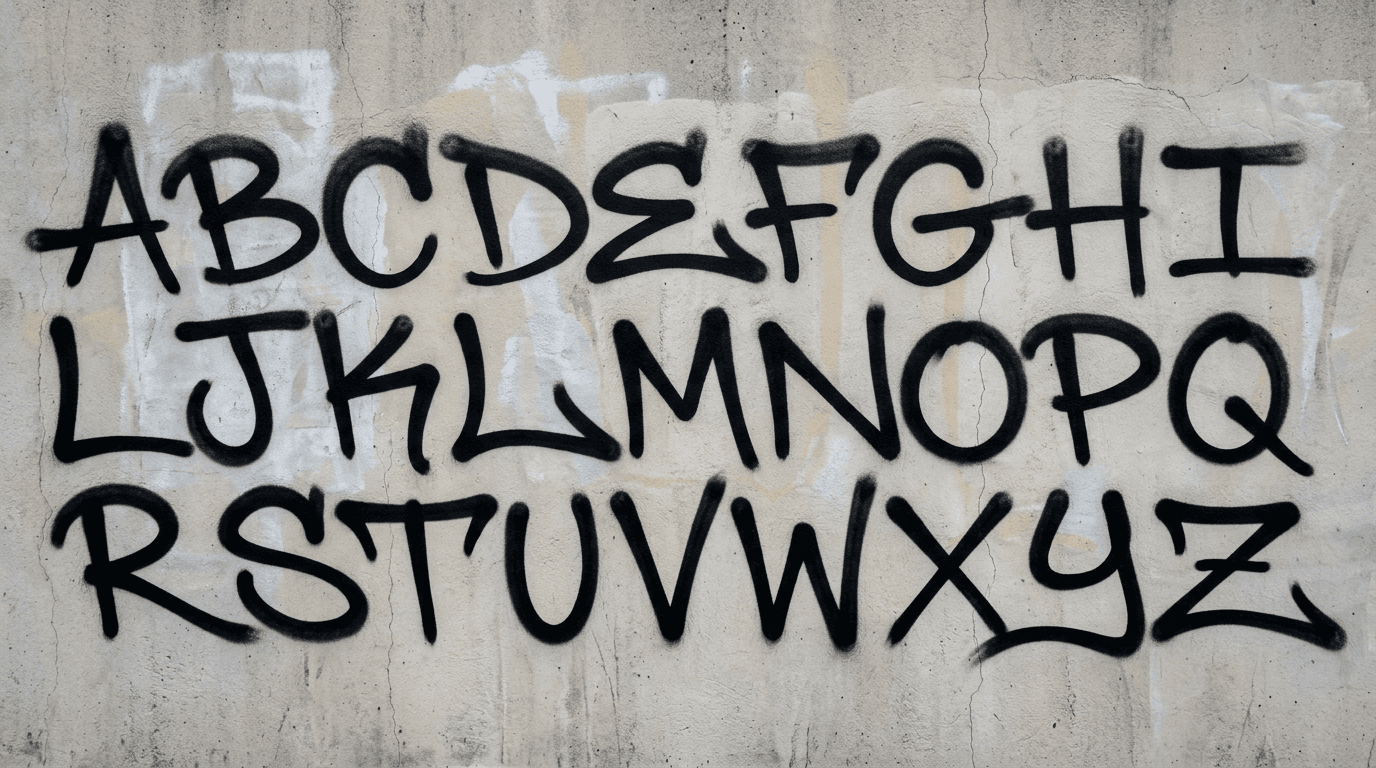
Railflow baseline pass generated through our /generate flow. It is plain on purpose: the letters stay readable, the spacing holds together, and the sheet gives you a clean base before you start pushing style.
Next Step
Run These A-Z Prompts in the Generator
Generate one letter family at a time so you can fix spacing and structure before chasing style.
Spacing and flow rules that keep words readable
Strong individual letters can still fail at word level if spacing changes on every pair. Define one default gap, then override only when collisions are obvious.
Test with short words first: FLOW, STYLE, RUSH, BOMB. If one pair looks off, fix the pair rule, not the whole alphabet.
This is where most people finally feel progress. A simple, readable word almost always teaches more than another overcomplicated alphabet sheet.
One useful reality check: if FLOW looks decent but STYLE collapses, your problem is probably not the whole alphabet. It is usually diagonals, tails, or one greedy letter that keeps stealing space from its neighbors.
R is a classic greedy letter. It can look sharp by itself, then wreck the word because the leg kicks too far out and breaks the rhythm.
- Keep baseline alignment consistent across all letters
- Use one default gap for most letter pairs
- Tighten only high-collision pairs like T+A or L+Y
- Run 4-8 letter word tests before heavy effects
Common beginner traps and fast fixes
Most beginners over-style too early, which hides structural problems. Diagnose structure first, then apply one style layer at a time.
If your alphabet looks inconsistent, compare only stems, counters, and spacing on a plain monochrome pass before touching color.
When a drill stalls, strip the pass back down and ask one blunt question: would these letters still read clearly without effects?
A good rule here is harsh but useful: when every letter is trying to be the star, none of them are doing the job.
That is why many first wildstyle attempts feel fake. The issue is usually not the style itself. The issue is that the writer moved into complexity before the base letters had enough control to carry it.
| Problem | Likely cause | Fast fix |
|---|---|---|
| Word is hard to read | Too many style add-ons in pass one | Remove effects, verify skeleton and spacing, then re-add one effect |
| Letters feel unrelated | Stroke width or corner logic changes per letter | Rebuild from anchor letters and lock one thickness range |
| Diagonal letters look broken | No shared angle rule for A/K/M/N/V/W | Set one diagonal angle family and rerun only that group |
| Output looks muddy | Prompt mixes too many goals in one run | Use one family prompt with one style goal per generation |
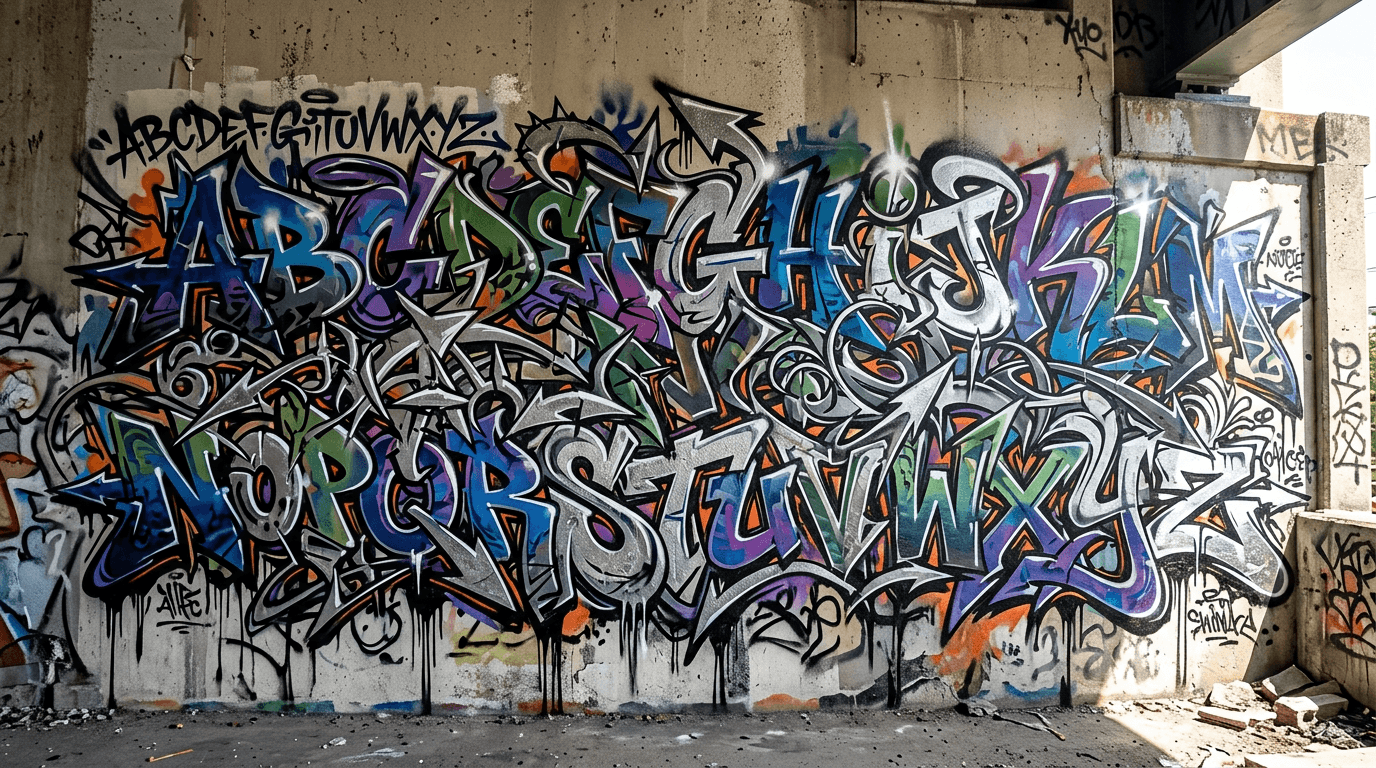
Volt-knot overstyle pass generated through our /generate flow. The energy is high, but overlap and effect stacking bury core letter structure; the problem is overload, not wildstyle itself.
What a bad drill session actually looks like
A bad session usually does not fail because you chose the wrong style. It fails because you start changing too many things at once. The first pass is shaky, so you add arrows. The second pass still feels weak, so you change weight and slant too. By the third pass, you do not know whether the problem is spacing, structure, or just the new effects you piled on.
A better recovery is boring on purpose. Keep the same four letters. Remove the extra effects. Fix one thing only, such as the A width or the R leg angle, and rerun. That kind of session feels less exciting in the moment, but it is the one that gives you a usable baseline sheet afterward.
This is the part newer writers skip. They would rather start a fresh page than admit the same weak E or R still needs another ten minutes. Veterans usually do the opposite: they stay with the ugly letter until it stops lying to them.
- Bad sign: every pass changes weight, slant, and effects at the same time
- Bad sign: one flashy letter gets all your attention while the rest stay weak
- Recovery move: rerun the same four letters with one change only
- Recovery move: save the cleanest plain pass before you add style back in
When this style is wrong for your goal
A single A-Z system is powerful, but it is not always the right choice. For expressive logos or battle-style pieces, strict consistency can feel too controlled.
Use this method for foundation and readability first, then loosen rules intentionally for specific creative goals.
In a blackbook, that control is useful. On a wall, it can also keep you honest. If the letters only work when everything is polished and perfect, they probably are not ready for bigger execution yet.
- Wrong fit: one-off logo concepts that need extreme letter distortion
- Wrong fit: mural ideas where composition matters more than uniform letters
- Right fit: practice sheets, usernames, merch drafts, and repeatable brand lettering
What to do next (10-minute drill)
Run one controlled session now: pick two anchor letters, one curve letter, and one diagonal letter. Generate, compare, and note one fix per letter.
Repeat this drill three times this week and your full A-Z consistency will improve faster than random long sessions.
After that, move back to /graffiti-letters, choose one new letter, and add it only after your original four feel stable.
If you cannot tell whether the session improved, print or save both passes and compare them cold an hour later. Bad spacing reveals itself faster when you stop staring at it in the moment.
- Generate one draft using your base system.
- Score each letter 1-5 for readability and consistency.
- Adjust one variable only: weight, corner, or spacing.
- Generate again and keep the better version as your reference sheet.
A weekly loop that keeps you from starting over every session
Use a fixed weekly loop so your improvements compound instead of resetting every session. Keep the baseline prompt or sketch logic stable for one week and only change what you are deliberately testing.
Do not chase novelty here. If every session feels brand new, you are probably dodging the same weak letter instead of fixing it.
A blackbook rhythm works well here: one family per session, one ugly problem to fix, one clean pass worth keeping. If you leave every session with only noise and no keeper, the loop is too loose.
- Mon: straight stems only. Judge whether your bars and verticals still look related.
- Tue: round forms only. Judge openings and counter clarity.
- Wed: diagonals only. Judge angle control and whether the letters lean as one family.
- Thu: leg and branch letters. Judge whether transitions look intentional or patched on.
- Fri: short word tests. Judge spacing, not decoration.
- Sat: fix the ugliest failure from the week instead of chasing something new.
- Sun: save one clean baseline sheet you would actually reuse next week.
Self-scoring rubric for A-Z consistency
Score each letter family on readability, spacing, and stroke consistency. Keep the rubric strict so you can detect real progress, not just stylistic variation.
If two categories score below 3 for two sessions in a row, repeat the same family before moving forward. Do not reward yourself for novelty when the letters are still unstable.
Keep the rubric mean enough to be useful. If you still have to explain why a letter almost works, it does not work yet.
- Readability: letter is clear at small size
- Spacing: side-bearings feel stable in short words
- Stroke logic: weight and corners stay consistent
- Change control: one-variable edits create predictable results
FAQ
Should I design all 26 letters in one session?
What is the fastest way to improve A-Z consistency?
What words should I use to test spacing?
Can one alphabet system work for multiple styles?
Related Reads and Next Actions
Next Step
Ready to Apply This in a Real Generation?
Run one 10-minute drill now, save the strongest pass, and turn it into your baseline sheet. If you start practicing often enough to hit free limits, then compare plan caps.