Styles
Old School Graffiti Letters vs Modern: What Changed, What Still Works
A practical comparison of old school graffiti letters vs modern styles, with drills, worked examples, and fixes for mixing both without losing readability.
Published Mar 29, 2026 · Updated Mar 29, 2026 · 13 min read · By SprayShift Editorial
Quick Answer
Old-school graffiti letters usually use wider bars, calmer joins, and cleaner distance readability. Modern letters push tighter spacing, sharper cuts, and more personal tension. If your sketches still wobble, study old-school structure first. If your structure already holds, borrow modern compression and cutbacks one move at a time instead of changing the whole word at once.
Who This Is For
Writers and designers trying to understand the real difference between classic old-school letter logic and newer modern styling, especially if their hybrids keep getting muddy.
Table of Contents
- The real difference is not age. It is what each style rewards.
- Old-school still teaches some things better than modern letters do
- Modern letters win when the structure is already honest
- You can spot the era shift fastest in M, A, R, and S
- Worked comparison: keep the word the same so the lesson is honest
- When should you choose old-school, and when should you choose modern?
- Failure example: the bad hybrid happens when both eras ask for the same space
- A 20-minute bridge drill for learning both without muddying both
- What is still worth stealing from each era
The real difference is not age. It is what each style rewards.
When most writers say old-school, they usually mean letter logic that still hits from distance: fuller bars, cleaner outline-and-fill decisions, calmer joins, and enough air for the word to read fast. That bias came from real viewing conditions. A lot of classic pieces had to hit on sight, not after a long close-up stare.
When they say modern, they usually mean tighter silhouette control and more personal tension inside the same word. You see harder cutbacks, stronger push-pull in the joins, more aggressive shape editing, and a willingness to make one side of a letter do more work than the other.
That does not make old-school basic or modern better. It just means they solve different problems. Old-school is still one of the best teachers for bar logic and repaintable structure. Modern is one of the best teachers for controlled personality once the bars already make sense.
| Trait | Old-school tendency | Modern tendency | What to borrow first |
|---|---|---|---|
| Bar shape | Fuller and calmer | Tighter and more carved | Keep the fuller base first |
| Spacing | More air between forms | Compressed with planned tension | Compress only after the word reads clean |
| Details | Simple arrows and cleaner fills | Sharper cuts, notches, and silhouette tricks | Add one modern move, not five |
| Readability test | Works better from distance | Works better up close when well built | Judge both at thumbnail size and from a few steps back |
Old-school still teaches some things better than modern letters do
If a writer's letters keep collapsing, old-school structure usually fixes the problem faster because it leaves fewer places to hide. Wider bars expose bad spacing. Simpler silhouettes expose weak counters. Cleaner joins expose whether the word actually moves left to right.
That is why old-school can feel easier until you try to repeat it well. A sloppy modern sketch can sometimes look exciting for a minute. A sloppy old-school piece just looks underbuilt immediately. That honesty is useful.
One practical observation that gets missed: old-school letters often repaint better. If you sketch a word, repaint it a second time, and it still holds the same bar weight and spacing, you probably have real control. That is harder to fake than a sharp-looking one-off sketch.
- Use old-school logic when you need to fix bar weight and spacing fast.
- Keep the counters open before you decide whether the word needs more style.
- Judge the piece from distance, not only close-up where detail can flatter weak structure.
- Repeat the same word twice. If the second pass falls apart, the first one was luck.
Modern letters win when the structure is already honest
Modern letter styling shines when the base word already works and you want more personality, sharper movement, or more tension between letters. The best modern pieces feel intentional, not busy. They compress where the old-school version leaves air, but they do it on purpose.
The hardest part is that modern styling punishes weak centers. If the middle of the word is already shaky, modern cutbacks and harder angles usually make that weakness louder instead of hiding it.
Another non-obvious thing: modern letters are not automatically narrower. Good modern structure still protects the important empty spaces. It just spends them differently. A lot of weak modern sketches are not too advanced. They are just under-edited.
- Use modern compression to increase tension, not to cram the word for no reason.
- Sharpen one or two structural edges before adding a whole family of cutbacks.
- Let one letter stay calmer so the more aggressive shapes have something to lean against.
- If the center starts closing up, go back to bar logic before you add more style.
You can spot the era shift fastest in M, A, R, and S
If a comparison stays vague, it usually means the writer never tested it on real letters. M, A, R, and S will expose the difference between old-school and modern decisions almost immediately because they punish bad spacing and fake aggression.
This is also where a lot of hybrid attempts go wrong. Someone sharpens the A, kicks the R leg harder, pinches the S tighter, and suddenly the word looks newer but reads worse. A stronger move is to keep three letters calm and let one letter carry the style jump.
- M: old-school usually leaves the shoulders wider and calmer; modern often tightens the center, so watch that the middle valleys do not choke.
- A: old-school likes a fuller body and an easy crossbar read; modern can sharpen the apex, but if the legs get too thin the letter turns brittle.
- R: old-school keeps the bowl and leg relationship obvious; modern can kick the leg harder, but only after the bowl break is stable.
- S: old-school gives the turns more breathing room; modern compression can make it feel meaner, but S is usually the first letter to turn to mush when the spacing gets greedy.
Worked comparison: keep the word the same so the lesson is honest
This is the fastest way to learn the difference. Do not compare two different words. Run the same word twice. When the letters stay the same, you can see what old-school width and modern compression are actually changing.
On the left, the old-school passes keep MOTION wide, open, and easy to repeat. On the right, the modern passes squeeze the same skeleton tighter and sharpen the joints. That only works because the counters and center movement still survive.
If you cannot tell which version feels stronger, ask a simpler question: which one would you trust to repaint larger tomorrow without improvising the whole middle again?
- Old-school MOTION reads faster because the bars and gaps do not compete with each other.
- Modern MOTION feels sharper because the cuts are coordinated, not random.
- The word would fail if the modern pass compressed the O and T without protecting their empty space.
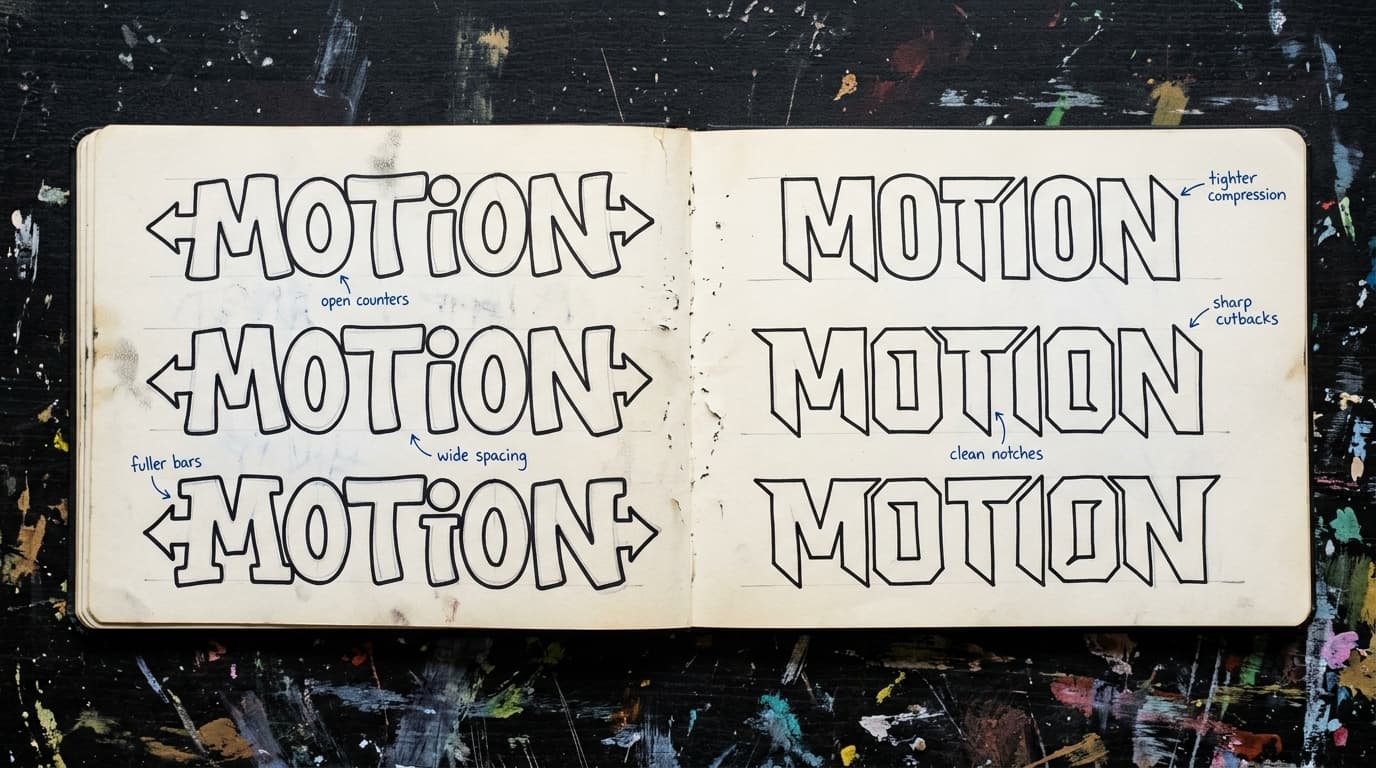
Useful comparison work keeps the word fixed. The old-school side wins on air and repeatability; the modern side wins on tension only because the bars are still under control.
Next Step
Run an Old-School Then Modern Pass
Keep the same word, keep the same baseline, and change only compression and detail level on the second pass so the comparison teaches you something real.
When should you choose old-school, and when should you choose modern?
Use old-school when you need the word to hit fast, scale up clean, or teach you something you can actually repeat tomorrow. Use modern when the base word already behaves and you want more pressure, more character, or a silhouette that feels less settled.
A lot of writers get stuck because they treat the choice like identity too early. It is usually just a session decision. Are you trying to fix the bars, or are you trying to sharpen the attitude?
| Situation | Better starting point | Why |
|---|---|---|
| Beginner practice | Old-school | It shows you the mistake instead of letting detail hide it |
| Big wall readability | Old-school | You get fewer nasty surprises when you step back from the wall |
| Blackbook exploration | Modern | Close-up pages can carry sharper tension and stranger silhouette decisions |
| Refining a personal style | Modern after old-school pass | You keep the base honest, then decide where to push |
| Repeating the same word cleanly | Old-school first | It tells you fast whether the structure is really yours or just a lucky sketch |
Failure example: the bad hybrid happens when both eras ask for the same space
This is the trap most people call style, but it is really indecision. The piece wants old-school fuller bars and modern sharp cuts at the same time, yet neither system gets enough room to finish the job.
Look at where it breaks first. The U and O crowd up, the baseline drifts through the middle, and the sharper finish on the N feels attached after the fact. Modern style is not the problem. Old-school influence is not the problem. The problem is borrowing both without deciding which structure owns the word.
A useful fix is subtractive, not additive: remove the sharp cutbacks first, reopen the counters, and see whether the old-school base suddenly reads better. If it does, rebuild the modern moves one at a time.
- Pick the owner system first: fuller old-school bars or tighter modern compression.
- Reopen the counters before you add more cutbacks or arrows.
- Keep the center of the word calmer than the opener and finish.
- If the modern move does not improve rhythm or silhouette, cut it.
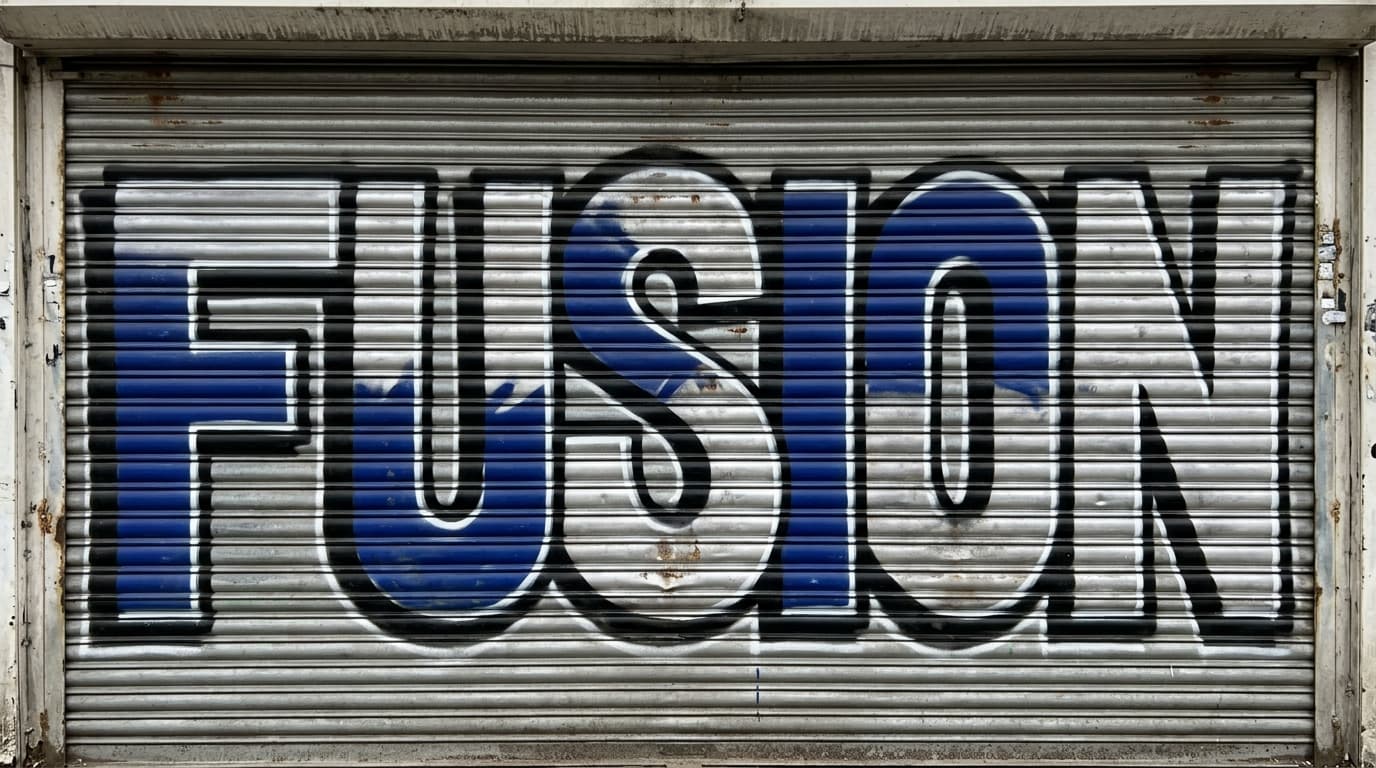
Failure example: this one is more useful because the base was almost fine. The trouble starts when a decent straight-letter structure gets pushed into uneven modern edits that tighten the middle for no real payoff.
A 20-minute bridge drill for learning both without muddying both
The cleanest way to study both eras is to run them in sequence, not all at once. Use one short word, one baseline, and one cap height for the entire drill.
The point is not to make both versions equally cool. The point is to see exactly when the modern pass starts helping and when it starts stealing air from the word.
- Minutes 0-5: draw one old-school skeleton and bar pass with fuller width and calm joins.
- Minutes 5-10: redraw the same word with the same baseline, but tighten spacing slightly and sharpen only two structural edges.
- Minutes 10-15: compare both versions at thumbnail size and circle the spots where counters or spacing broke first.
- Minutes 15-20: make one third pass using the stronger base and only one borrowed move from the other style.
| Word | Why it helps | What to watch |
|---|---|---|
| MOTION | Mixes rounds, stems, and a diagonal finish | Whether the O and N still breathe after compression |
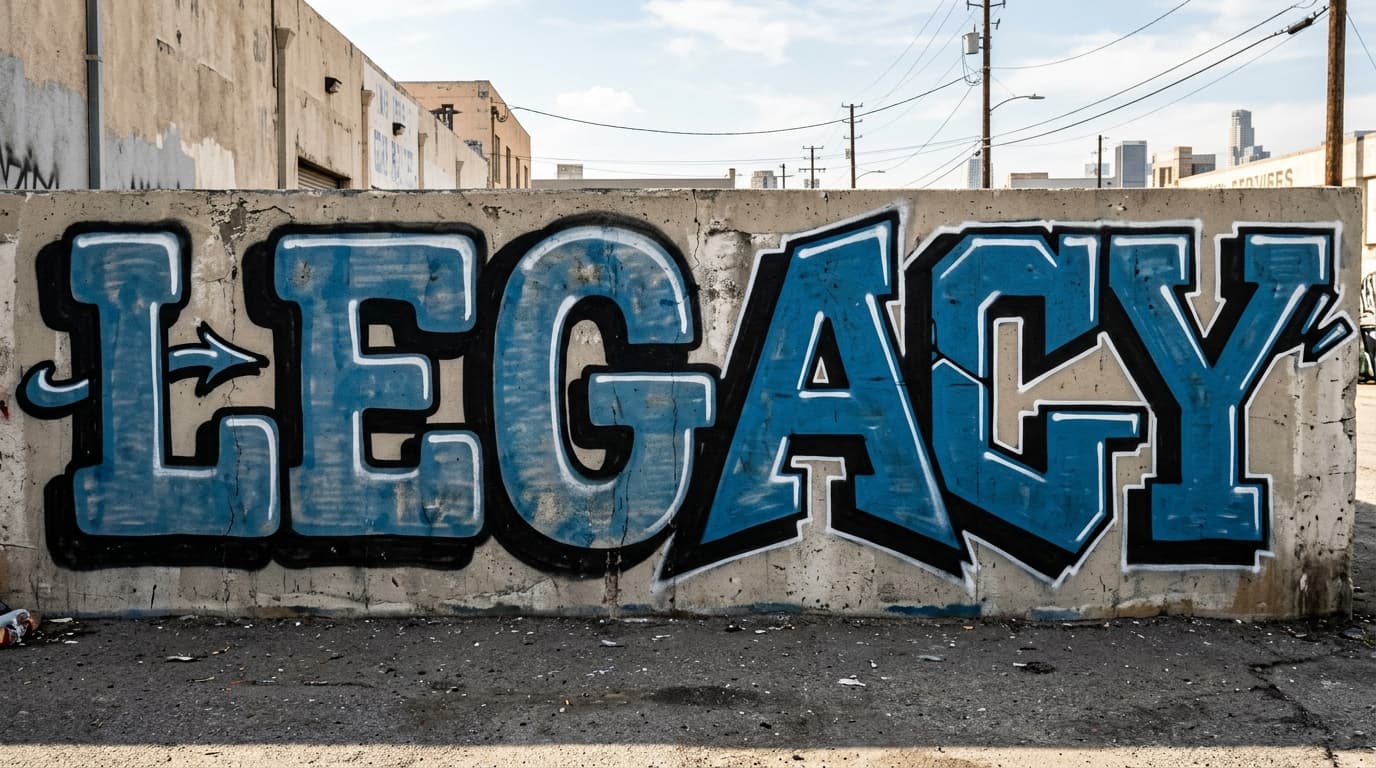
| LEGACY | Shows how a wide word handles sharper back-half cuts | Whether the A and C keep enough air |
| FUSION | Exposes overworked centers fast | Whether the U, S, and O start colliding |
What is still worth stealing from each era
From old-school, steal the patience. Fuller bars, readable distance, and the nerve to leave a word simple when simple is the right answer. A lot of people skip that part because simple feels less impressive on the page. It usually paints better, though.
From modern lettering, steal the editing eye. Not the aggression by itself, but the willingness to cut, tighten, and make a letter commit to one sharper decision instead of hiding behind decoration.
The strongest hybrids almost never split the difference evenly. They let one system own the build, then they steal one or two useful moves from the other. That is why they feel intentional instead of crossbred.
- Steal old-school bar discipline before you steal old-school nostalgia.
- Steal modern editing before you steal modern aggression.
- Make the word earn its details instead of paying them out on line one.
FAQ
Are old school graffiti letters better for beginners?
What makes modern graffiti letters look modern?
Can you mix old-school and modern graffiti letters?
Which style reads better from distance?
How should I practice both styles without getting confused?
Related Reads and Next Actions
Next Step
Ready to Apply This in a Real Generation?
Pick one six-letter word today and draw it twice: once with old-school patience, once with modern tension. The version that still reads after you strip the extras is the one worth building on.