Letters
Graffiti Alphabet Letters Practice Guide: Train Families, Not Random A-Z Rows
Use this graffiti alphabet letters practice guide to split A-Z into letter families, run cleaner 20-minute drills, and fix spacing before style turns noisy.
Published Mar 22, 2026 · Updated Mar 22, 2026 · 12 min read · By SprayShift Editorial
Quick Answer
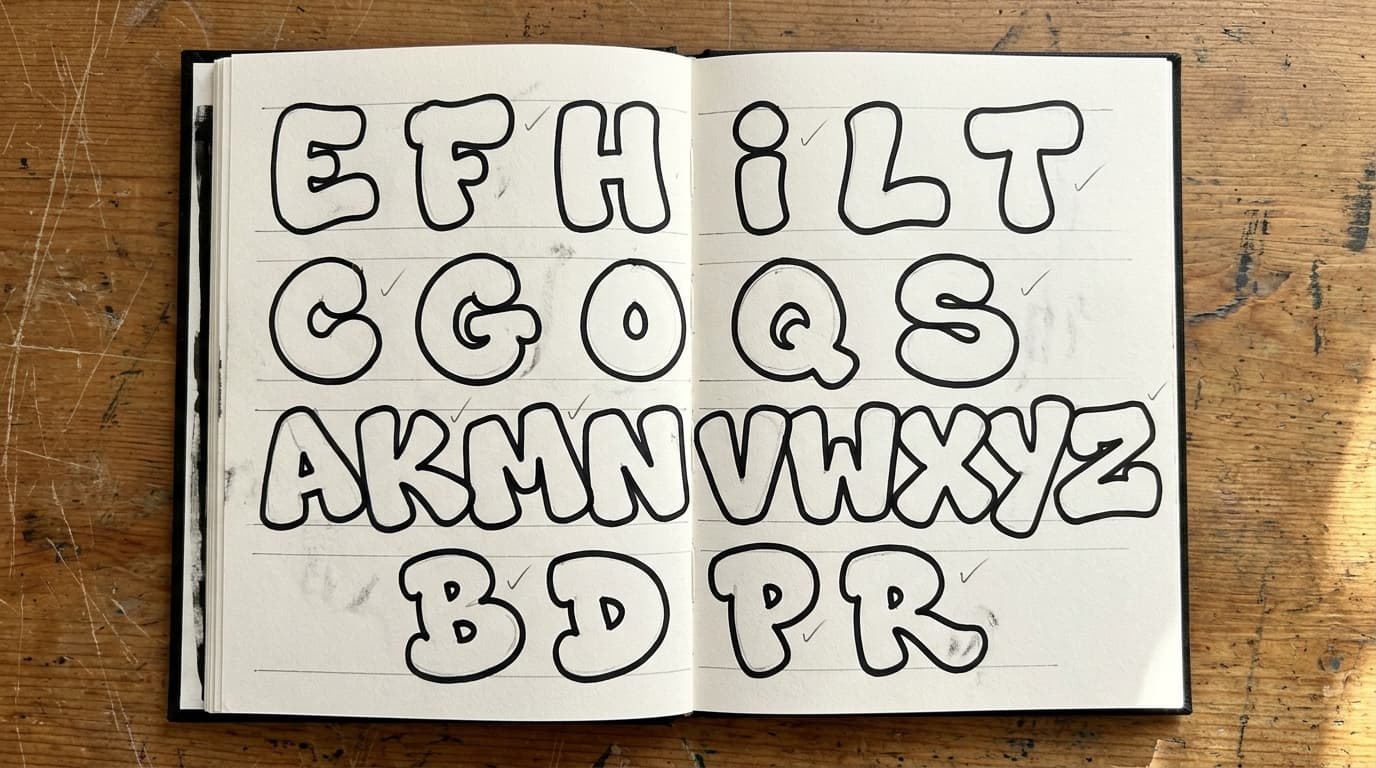
The fastest way to improve graffiti alphabet letters is to stop redrawing A-Z in order every session. Split the alphabet into straight, round, diagonal, and branch families, drill one family at a time, and then test that family in a short word. If you are brand new, start with straight and round letters first and leave the harder diagonal rows for later.
Who This Is For
Beginners who want a practice routine that feels manageable, plus improving writers who are tired of making full A-Z sheets that do not help their actual words. If this is your first week, this guide should still make sense.
Table of Contents
- Stop running A-Z in order every session
- Practice by family so one fix carries to six letters
- Build one four-lane rotation sheet
- Worked example: this practice spread gets cleaner without getting stiff
- Use benchmark words instead of admiring isolated letters
- Failure example: too many rules changed at once
- A 20-minute alphabet practice loop that actually transfers
- Score the family, not the prettiest letter
Stop running A-Z in order every session
A full A-Z page looks productive, but it usually hides the exact thing you need to fix. By the time you reach the last row, you are tired, your spacing starts drifting, and the early mistakes are buried under twenty more letters.
That is why so many alphabet drills feel busy but do not help much when you try to spell a real word. Finishing the alphabet is not the same as improving it.
A better question is simple: which group of letters got cleaner today, and does that cleaner version still hold up inside a word?
- Practice one family before you practice the whole alphabet
- Repeat the same baseline and cap height for that family
- Judge side spacing before decorative add-ons
- Test the family in a word before you call the drill done
Practice by family so one fix carries to six letters
Letter families make practice easier because one fix can help several letters at once. Straight letters teach height and bar weight. Round letters teach open counters, which is just the empty space inside letters like O and G. Diagonal letters teach angle control. Branch letters such as B, D, P, and R teach you how bowls and legs join a main stem.
This is the part many people skip: every family needs a test word. A single letter can look fine on its own and still fall apart when it has to sit next to other letters.
A small rule that helps a lot: diagonal families need one shared angle. If your A leans one way, your N another, and your V opens much wider than both, the whole row starts looking patched together.
| Family | Letters | Watch first | Benchmark word |
|---|---|---|---|
| Straight stems | E F H I L T | Height drift and bar weight | HILL |
| Round forms | C G O Q S | Counter placement and curve tension | COOL |
| Diagonals | A K M N V W X Y Z | Shared angle logic and shoulder width | MANY |
| Branch letters | B D P R | Bowl-to-stem joins and leg exits | BORN |
Build one four-lane rotation sheet
A good practice page does not need to be pretty. It needs to let you compare one row against the next. Divide the page into four lanes and give each lane one family. That way you can see stem problems, counter problems, and diagonal problems on the same sheet.
Use one simple style language across the page. If the straight family is blocky, do not let the round family suddenly turn soft and puffy just because curves feel easier. The rules need to stay shared or the page stops teaching you anything.
If this is your first serious alphabet session, start with two lanes only: straight and round. That already covers a lot, and it is easier to judge honestly than trying to tame all four families at once.
- Split the page into four horizontal lanes: straight, round, diagonal, and branch letters. If you are new, begin with only the first two lanes.
- Choose one style language for the whole page: mostly block, mostly rounded, or a calm hybrid.
- Draw or generate each family with matching cap height, baseline, and bar weight before you add any effects.
- Circle only the letters that still fail, then retest those shapes inside a benchmark word.
Next Step
Build a Letter-Family Practice Sheet
Run one family at a time so you can judge consistency, spacing, and shared structure before the whole alphabet gets noisy.
Worked example: this practice spread gets cleaner without getting stiff
This practice spread works because the second page is clearly calmer than the first. The words still have character, but the spacing is steadier, the round letters stay open, and the diagonals in MANY stop arguing with each other.
That is what useful progress looks like. Not a magical style jump. Just a cleaner rewrite of the same small group of problems.
A practical note: HILL and COOL usually settle first. MANY often takes longer because diagonal letters are less forgiving. That is normal, not a sign you picked the wrong word.
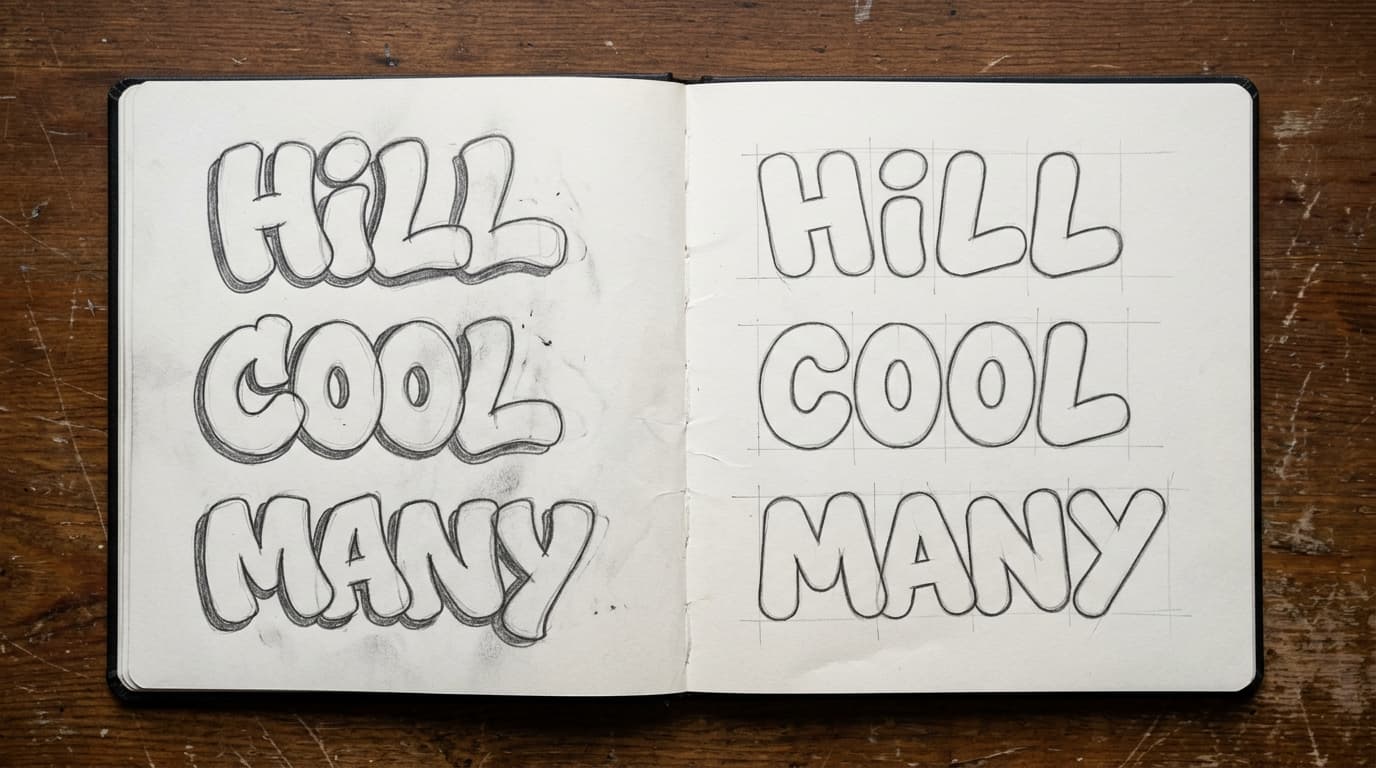
Worked example: the first page finds the problem, and the second page solves it with cleaner spacing, calmer counters, and a more consistent diagonal angle.
Use benchmark words instead of admiring isolated letters
Benchmark words are short words that test whether your practice row works in real use. That is the whole point. A letter can look strong alone and still fall apart the second it has to share space with three neighbors.
Keep the words short and practical. HILL tells you whether stems can repeat without drifting. COOL tells you whether round counters stay centered. MANY shows if diagonals agree on one angle. BORN exposes weak bowl exits and awkward R legs fast.
This is also the best way to use the generator here. Do not ask for a huge alphabet sheet every time. Ask for the one benchmark word that belongs to the family you are studying.
- HILL reveals whether repeated stems stay calm or start widening one by one.
- COOL reveals whether your O stays centered once another round letter joins it.
- MANY reveals whether diagonal shoulders share one family angle or wander apart.
- BORN reveals whether branch letters really connect or just pretend to from a distance.
Failure example: too many rules changed at once
This page fails because too many things changed at once. The straight letters get too heavy, the round letters crush their inner space, and the diagonal letters stop agreeing with each other.
That is a very normal beginner mistake. You notice one weak row, then start inventing a different fix for every next letter. By the end of the page, nothing belongs together anymore.
When that happens, do not try to save the whole sheet. Keep the cleanest family, throw the rest away, and rebuild from the one rule that still looks solid.
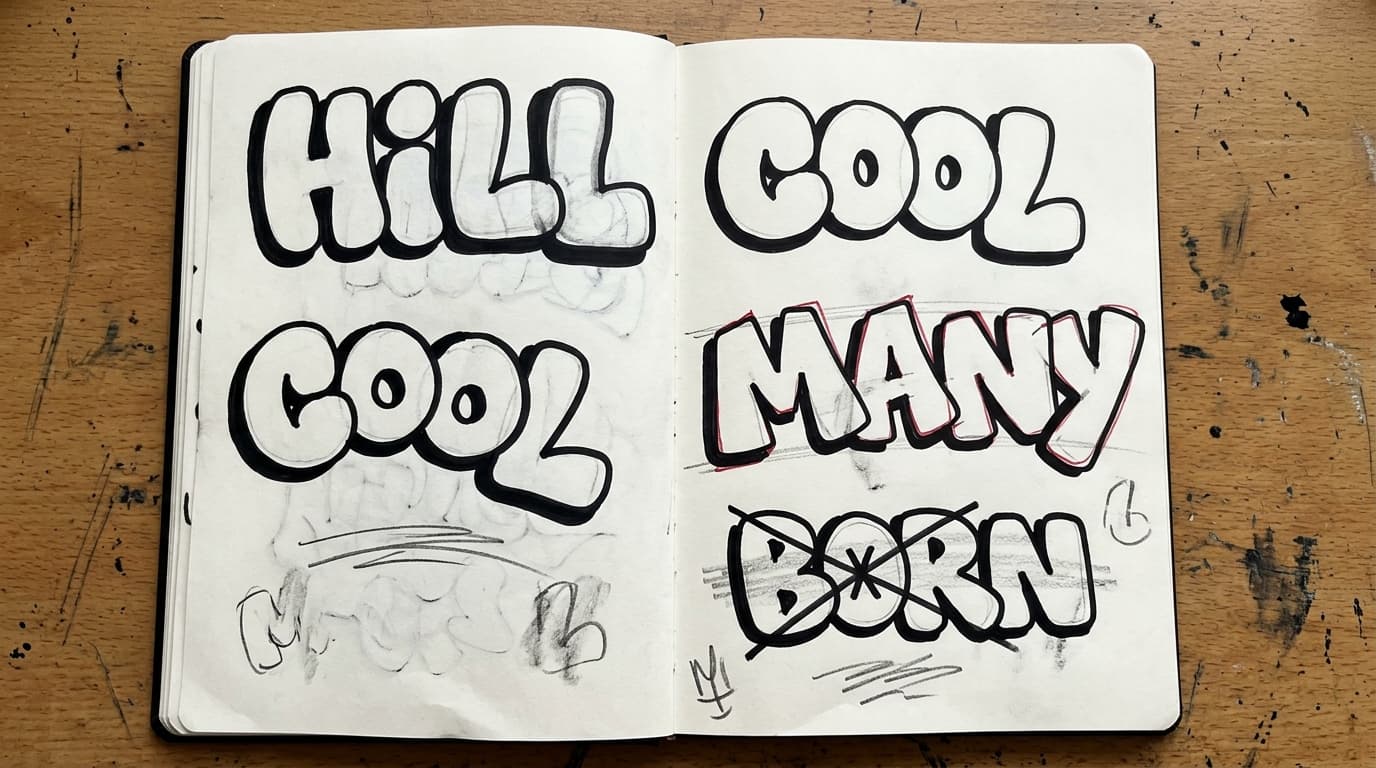
Failure page: the problem is not ambition, it is rule drift. Each family starts answering a different question, so the page stops feeling related.
A 20-minute alphabet practice loop that actually transfers
Short loops work better than giant alphabet marathons because you can still remember what changed. In twenty minutes, you should be able to name one fix, test it in one word, and keep one row that is better than your first pass.
Stay narrow. If diagonals are the problem today, do not wander off into round letters just because they feel safer.
- Change one variable per session, not three
- Write down which letter pair failed inside the benchmark word
- Keep the best row so tomorrow's page has a real baseline
| Minutes | Focus | Output |
|---|---|---|
| 5 | Choose one family and sketch the raw row | One messy first pass |
| 5 | Unify one rule only | One cleaner family pass with shared height or angle |
| 5 | Pressure-test with a benchmark word | One short word that exposes the weak pair |
| 5 | Rebuild only the failed letters | One final pass you would keep as a reference |
Score the family, not the prettiest letter
One clean letter can fool you into thinking the whole page improved. Score the family instead. If the A looks good but the M, N, and V still disagree about angle and width, the diagonal family is not ready yet.
A good scorecard is plain on purpose: readability, spacing, shared structure, and whether the family still works inside one short word. If two of those are still shaky, rerun the same family next session.
- Readability: the family still reads when you step back from the page
- Shared structure: repeated forms look related, not copied from different moods
- Word transfer: the benchmark word got calmer on the second pass, not busier
FAQ
How should I practice graffiti alphabet letters?
What is a letter family in graffiti practice?
What are the best words to test a graffiti alphabet practice sheet?
When should I move from family drills back to a full A-Z sheet?
Related Reads and Next Actions
Next Step
Ready to Apply This in a Real Generation?
Keep one family honest today, then test it inside a short word tomorrow. That is a better use of practice time than redrawing 26 unrelated letters and hoping the problem reveals itself.