Practice Prompts
Graffiti Drawings: 15 Practice Prompts That Build Skill
Use 15 practical graffiti drawings prompts plus easy first-draw ideas to practice stencil scenes, characters, and believable wall art.
Published Mar 9, 2026 · Updated Mar 9, 2026 · 11 min read · By SprayShift Editorial
Quick Answer
If you are stuck on what to draw, do not overthink it. Start with subjects that already make sense on a wall: rats, pigeons, cameras, gloves, masks, and skaters. Use stencil prompts when you want clean shape and character prompts when you want pose. Keep the prompt short. One prop is enough. If the silhouette does not work, more detail will not rescue it.
Who This Is For
Beginners who need clear ideas for what to draw first, plus generator users who want believable graffiti art instead of overbuilt concept scenes that fall apart on the wall.
Table of Contents
- What makes a graffiti drawings prompt useful instead of random?
- What are the easiest graffiti drawings to start with?
- Use this 3-pass loop before you start chasing detail
- Which graffiti drawings prompts are actually worth practicing first?
- Stencil prompt example: keep silhouette stronger than detail
- Character prompt example: give the wall one job and the character one attitude
- What beginners should stop trying to draw for now
- What should you do next? Run one short drawing session with a scoreboard
What makes a graffiti drawings prompt useful instead of random?
A good graffiti drawing should read fast. You should be able to imagine spotting it across the street and knowing what it is right away. If the idea needs explaining, it is already doing too much.
The wall matters as much as the subject. A lot of weak graffiti art dies because the prompt is trying to tell a story, show off detail, and fake realism all at once. I would rather see one clean idea on a believable wall than a crowded prompt pretending to be a mural.
- Could someone identify the subject from the silhouette alone?
- Is there only one main subject?
- Is there one prop at most?
- Does the wall still sound like a real wall, not a movie set?
- Would the idea still work without extra text?
What are the easiest graffiti drawings to start with?
Start with subjects that already belong on a wall. Usually that means animals, objects, or one character with one obvious mood. Do not start with a full crew mural, a chase scene, or a character tangled up with giant lettering. That is how people end up blaming the tool for a bad idea.
If you want quick wins, pick subjects with a strong outline and one simple prop. Those survive weak generations better, and they make it painfully obvious what actually improved the image.
- Rat with a marker or spray cap: easy silhouette, instantly reads as street art, perfect for stencil practice
- Security camera with a spray halo: good for icon-style graffiti drawings and raw concrete walls
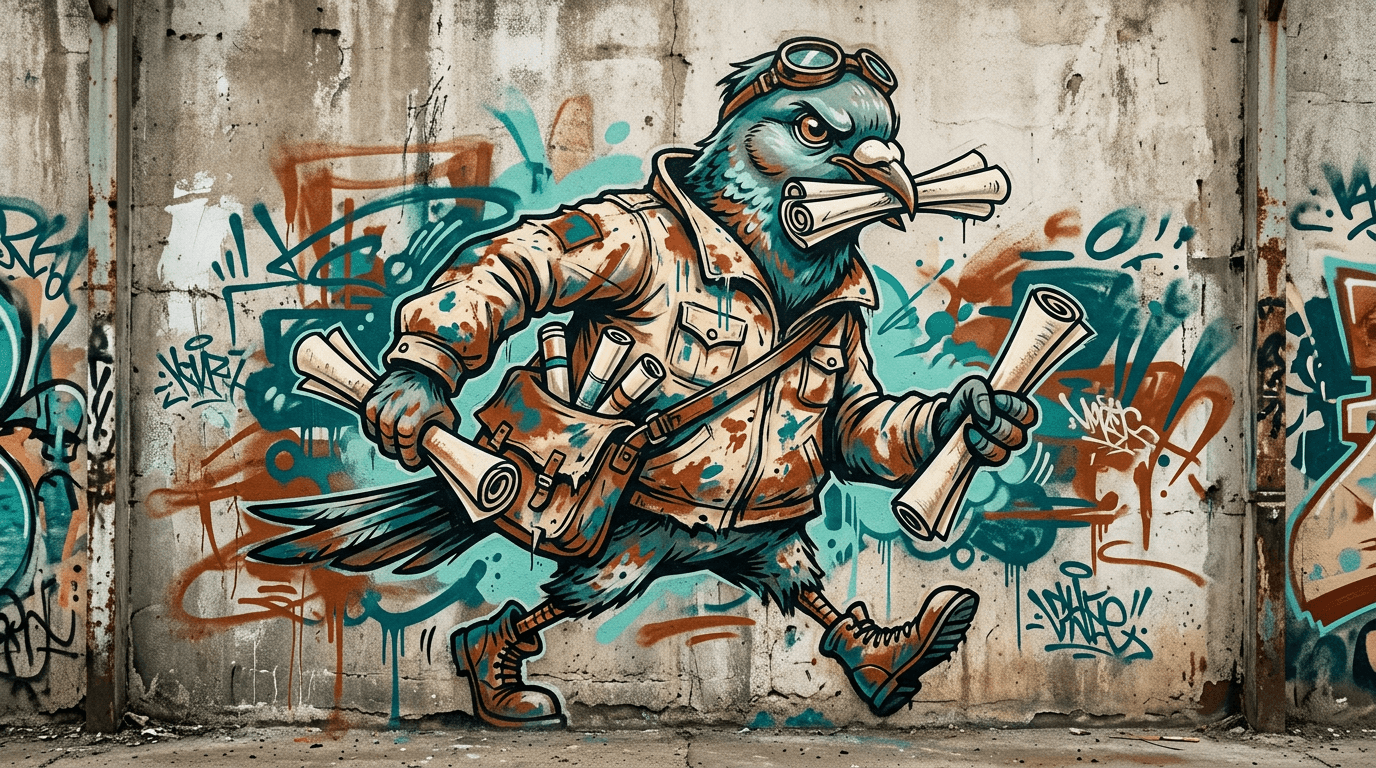
- Pigeon carrying sketch rolls: funny, clear, and better than another generic skull
- Skater character mid-push or mid-landing: strong movement without needing a big scene
- Mask, gloves, flashlight, and caps on the ground: useful when you want a still-life prompt instead of a mascot
Use this 3-pass loop before you start chasing detail
Most bad outputs fail because the first prompt is already trying to finish the whole wall. Do not do that. Build the image in three passes: silhouette first, attitude second, wall texture third.
It is not clever, but it works. If the subject still looks weak after pass one, extra detail is just camouflage.
- Write the subject first: rat, pigeon courier, skater, camera, gloves, robot, or cone monster.
- Add one prop that explains the scene: marker cap, sketch roll, boombox, extension cord, mop bucket, or backpack can.
- Choose style before mood. Use stencil when you want hard cut shapes. Use character when you want pose and personality.
- Run pass one with shape only and no dramatic lighting language.
- Run pass two by adding attitude, motion, or one costume detail.
- Run pass three by adding wall texture, drips, or wear, then stop when the image starts getting crowded.
Which graffiti drawings prompts are actually worth practicing first?
These are actual starting prompts, not vague themes. Copy one, run it, then rewrite only the part that failed. That teaches you more than inventing a brand-new prompt every round and hoping this one is magic.
They start easy and get a little trickier. The stencil prompts train shape discipline. The character prompts push pose, props, and scene control.
- Stencil: city rat holding a marker cap, painted on a cracked underpass wall, two-tone black and cream, raw wall texture visible, slight overspray, no text
- Stencil: old security camera with a fresh spray halo, painted on rough concrete, hard cut shapes, monochrome, no frame, no extra objects
- Stencil: paint gloves, caps, and a flashlight arranged on wet pavement, high contrast, simple composition, real spray texture, no lettering
- Stencil: traffic cone monster with dripping teeth, painted directly on a stained wall, black and off-white only, strong negative space, no background panel
- Stencil: torn poster face with a fresh stencil sprayed over it, wall layers visible, gritty texture, monochrome, no extra scene elements
- Stencil: broken street sign reshaped into a bird head, sprayed on raw concrete, sharp cut shapes, slight overspray, no color gradients
- Character: courier pigeon carrying rolled sketch paper, mid-stride, painted on a warehouse wall, teal rust and cream palette, no text
- Character: lanky skater character mid-push with a spray can clipped to a backpack, raw brick wall, orange and white palette, strong motion
- Character: bulldog mechanic with a spray-can bandolier, painted on an old garage wall, bulky shapes, limited palette, no lettering
- Character: robot writer leaning on a mop bucket, alley brick wall, expressive face, worn metal details, tight palette, no text
- Character: runner climbing down a fire escape painted across a narrow wall, long vertical pose, muted palette, no extra characters
- Character: mascot holding an extension cord like a rope, real warehouse wall, cartoon energy, one prop only, no text
- Character: crew mascot stepping over train tracks, wide wall composition, strong silhouette, limited palette, no background crowd
- Character: kid in oversized gloves holding two caps and looking over one shoulder, raw wall, clear facial expression, no extra props
- Character: sleepy alley cat wearing a paint-stained hoodie, sitting beside a milk crate and boombox, brick wall, low-color palette, no words
Next Step
Run the Stencil Prompt Set
Keep the subject simple, hold the image to two tones, and test one wall texture at a time so silhouette mistakes stay obvious.
Stencil prompt example: keep silhouette stronger than detail
Stencil prompts live or die on shape. If the subject does not read instantly, the image starts feeling like poster art instead of real wall work.
This is where beginners usually wreck a decent idea. They ask for fur texture, dramatic environment, and a pile of mood words. Wrong move. Two tones and one prop is usually enough.
- Good stencil subjects have a clear side profile or front profile
- One prop is enough to tell the story
- Raw wall texture should stay visible through the whole image
- If the shape still reads when you squint, the prompt is ready
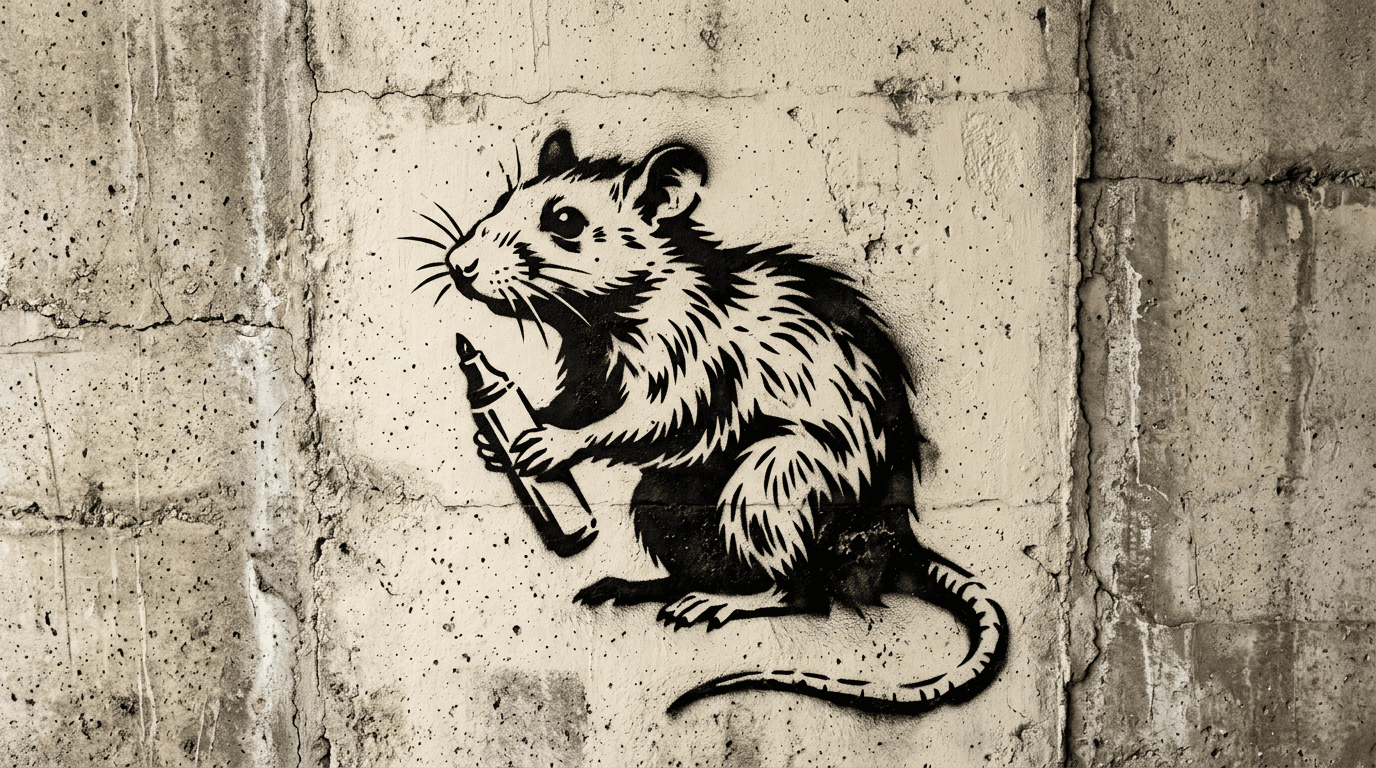
Worked stencil example: the rat reads fast because the silhouette does the heavy lifting. Two tones, one prop, and plenty of raw wall texture make it feel painted on concrete instead of dropped in as poster art.
Character prompt example: give the wall one job and the character one attitude
Character prompts go bad when people try to direct a whole animated short in one sentence. You do not need that. You need one body position, one clear expression, and one prop that explains the scene.
The skater image works because it stays narrow. The pose sells the motion, the backpack cans do enough storytelling, and the brick wall still looks like brick. Nothing important is fighting for attention, which is exactly the point.
- Pose first, clothing second, wall texture third
- Use a tight palette so the wall still feels painted, not digitally rendered
- Keep facial expression readable from a distance
- If the prop overlaps the hands, rewrite that line before adding more detail
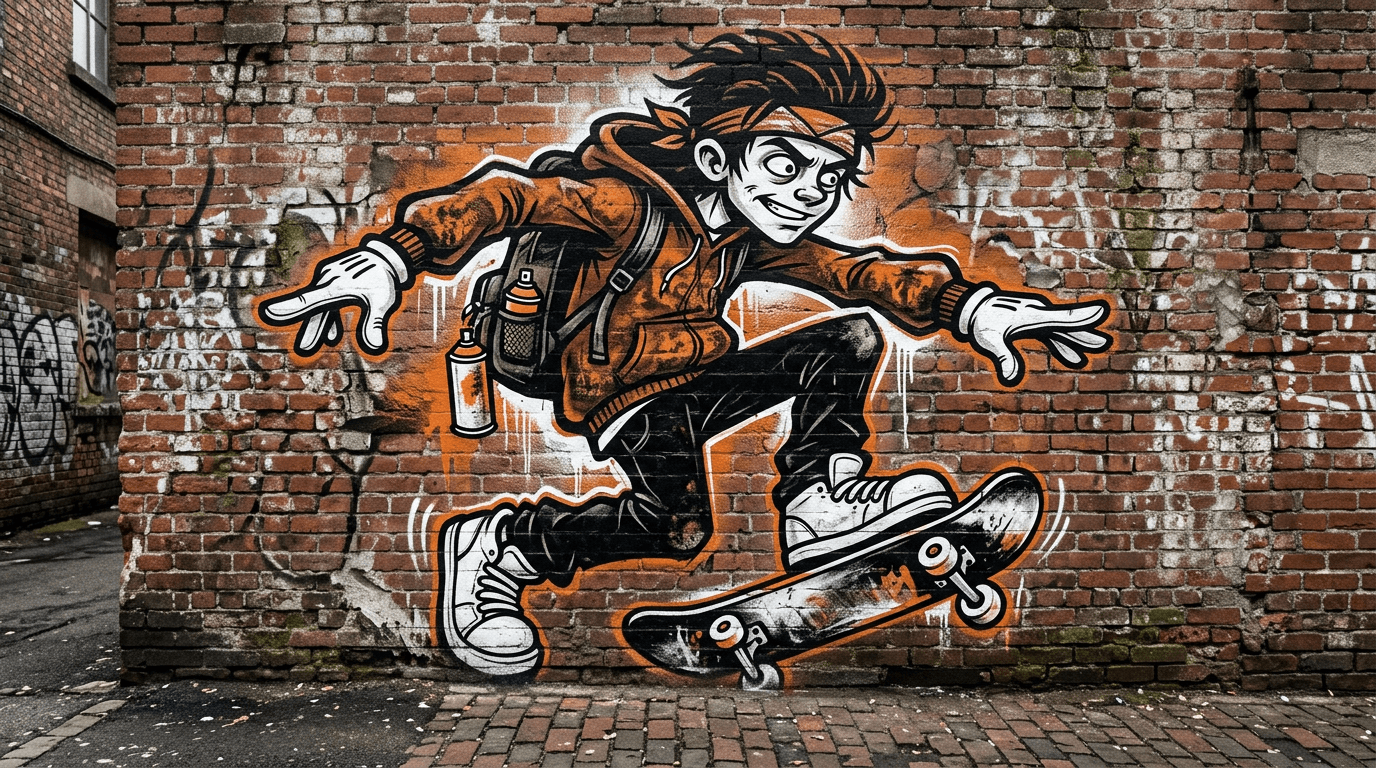
Worked character example: this one holds together because the pose is clear, the brick wall stays believable, and the prop count stays low. You get movement and attitude without turning the mural into a crowded comic panel.
What beginners should stop trying to draw for now
If you are still learning, stop trying to make full mural scenes with characters, letters, effects, and cinematic backgrounds in the same prompt. That is not advanced. It is just overloaded.
Also stop reaching for generic edgy filler when you do not know what to draw. Another skull, another demon face, another cyberpunk alley does not magically make the image stronger. Most of the time it just means you do not have a real idea yet.
- Full scene plus lettering plus character: split it into two separate exercises
- Movie-poster framing: rewrite the wall description so it sounds like a real place
- Fake grit words stacked everywhere: cut half of them and keep one useful surface note
- Character feels stiff: fix the pose before touching color or effects
- Stencil looks pasted on: remove anything that sounds like a frame, panel, or background patch
What should you do next? Run one short drawing session with a scoreboard
Do not try all 15 prompts tonight. Pick one easy stencil, one moving character, and one object-based prompt. That is enough to show you where your taste is shaky and where your prompt writing gets lazy.
Save the ugly result too. The bad version is usually more useful because it shows exactly where the prompt got greedy.
- Choose one stencil subject, one character subject, and one hybrid or prop-based subject.
- Generate each subject once with the shortest workable prompt.
- Give each result a 1-5 score for silhouette, realism, and unnecessary clutter.
- Rewrite only the weakest line in each prompt.
- Run a second pass and keep the version that reads better at thumbnail size.
- Save your best prompt as a reusable baseline for the next session.
FAQ
What should beginners draw first in graffiti?
Are stencil prompts better than character prompts for beginners?
How much detail should a graffiti drawing prompt include?
Can I mix lettering with graffiti drawings in the same prompt?
Why do some graffiti drawings look fake even with a good idea?
Related Reads and Next Actions
Next Step
Ready to Apply This in a Real Generation?
Open one stencil prompt and one character prompt right now. Run both. Keep the one that still looks good small, and fix the one that fell apart. That habit will improve your eye faster than hammering the same overloaded prompt ten times in a row. If you start using the generator like a sketchbook, more monthly generations will make that routine easier to keep up.