Letters
Graffiti Letter Combinations That Work: Joins, Flow, and Bad Pair Fixes
A practical graffiti letter combinations guide for choosing pairs that flow, fixing bad joins, and building words that do not collapse in the middle.
Published Apr 26, 2026 · Updated Apr 26, 2026 · 13 min read · By SprayShift Editorial
Quick Answer
Good graffiti letter combinations are pairs that pass weight cleanly from one letter to the next. Start with AR, RA, OC, ST, UN, and ER. Those pairs teach diagonal handoffs, round-form breathing room, narrow-letter control, and exits that do not panic. Do not judge letters alone. A good solo letter can still wreck the word when the next letter steals its spacing, slant, or counter.
Who This Is For
Writers and beginners who can draw individual letters but keep losing the word once two letters have to sit together, especially in straight letters, tags, throw-ups, and early piece sketches.
Table of Contents
- The word lives or dies in the pairs
- Letter combinations that usually give you flow
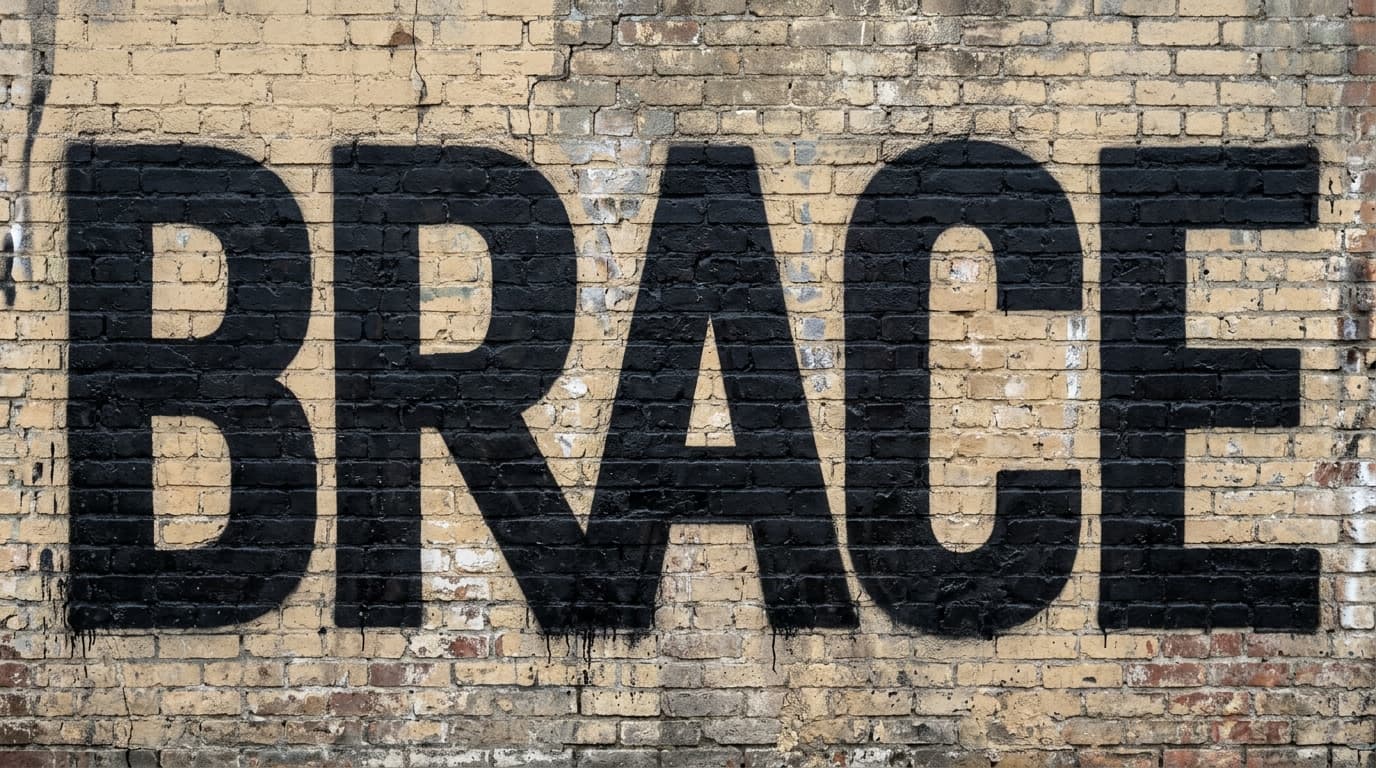
- Full word teardown: why BRACE holds together
- A blackbook drill that fixes joins faster than another alphabet sheet
- Bad combinations are not cursed. They are just expensive.
- Failure example: when one cramped pair ruins a readable word
- Words that give you useful combinations without turning into homework
- The same pair changes when the style changes
- What I would drill tonight
The word lives or dies in the pairs
Most weak pieces do not fail because every letter is garbage. They fail in the little handoffs. The B looks fine. The R looks fine. Then the space between them gets swallowed, the next letter has to lean too hard, and suddenly the whole word is limping.
That is why judging single letters can fool you. An A after an R is not the same job as an A after an O. Same letter, different pressure. One neighbor gives it a diagonal to answer. Another gives it a round shape that needs air.
So look at the word in pairs. Where does weight pass across? Which counter needs more room? Does the slant keep moving, or does one letter put the brakes on? If every letter tries to win by itself, the word gets noisy fast.
- Box the two worst joins before redrawing the whole word
- Keep one shared baseline until you can explain why you are breaking it
- Open counters before you thicken the outline
- Make the quieter letter do its job; not every letter needs a flex
Letter combinations that usually give you flow
No pair is magic. A good writer can make ugly combinations work, and a beginner can kill an easy one in two strokes. Still, some pairs teach cleaner decisions faster. These are the ones I would give somebody before they burn a whole page chasing dramatic endings.
Do not memorize the list like a cheat code. Feel the trade. Round into straight. Diagonal into round. Narrow into wide. That contrast is where rhythm starts. Too much sameness gets stiff. Too much contrast turns into a car crash.
| Pair | Why it works | Watch for |
|---|---|---|
| AR | The A can hand a diagonal into the R leg without killing momentum | Do not let the R bowl crowd the A counter |
| RA | The R gives weight and the A can answer with a strong lean | The A often gets too wide trying to prove itself |
| OC | Two round forms teach breathing room and counter control | If the gap closes, both letters turn into one blob |
| ST | A sharp S into a simple T teaches narrow-letter discipline | The T can feel pasted on if the S steals the baseline |
| UN | Open U into firm N gives a clean middle for straight letters | The N can become too heavy and bully the U |
| ER | The E sets structure and the R gives the pair a usable exit | Equal spacing can look neat but still feel dead |
| LA | Good for learning how a vertical stem hands into a diagonal | The L disappears if the A leans too hard into it |
| MP | Heavy pair that teaches weight control and counter space | Easy to choke the P after a fat M |
Full word teardown: why BRACE holds together
BRACE is not the flashiest word. Good. Flashy words let you hide. BRACE makes you deal with five different handoffs without turning the page into alphabet homework.
Look at the hero image like a critique, not a finished flex. The B and R are both heavy, so the danger is a fat opener that eats the first half. The A gives the word a tall center, but if it leans too much, it shoves the C into the E. The C-E finish works because it calms down instead of trying to outshine the middle.
That is the lesson: a word can have attitude without every join being aggressive. Sometimes the best move is letting one pair breathe so the next pair has somewhere to land.
- Copy the word once as plain block letters before trying style.
- Redraw only the B-R and A-C joins if the whole word feels cramped.
- If the C-E finish looks boring, good. A quiet finish can make the center hit harder.
| Join | What to inspect | If it goes wrong | Fix |
|---|---|---|---|
| B-R | Does the R have room after the B bowl? | The opener becomes one black wall | Narrow the B or give the R leg a cleaner lane |
| R-A | Does the diagonal energy continue? | The A gets too proud and widens the word | Let the A answer the R, not overpower it |
| A-C | Is there enough air after the center letter? | The C looks like it got squeezed in late | Open the gap before adding outline weight |
| C-E | Does the finish stay calm? | The E feels pasted on or too stiff | Keep the E simple and make its bars echo the earlier weight |
A blackbook drill that fixes joins faster than another alphabet sheet
Alphabet sheets are useful, but they can lie to you. A clean solo R does not prove the R works after an A, before an E, or jammed into a tight middle. Pair drills make the lie show up on the page.
Draw the same pair ten times. Not the whole word. Just the handoff. Keep it simple enough that you can see the bars. If the second letter keeps getting wider, higher, or more dramatic, that is the problem. Do not decorate around it.
One small trick: leave the failed version on the page. Do not erase it immediately. Put the fixed version beside it. Your eye learns faster when it can compare the bad gap to the better one.
- Pick four pairs from one word, not random letters from the alphabet.
- Draw each pair as plain skeleton letters first.
- Build bars over the skeleton and keep one cap height.
- Circle only the gap, counter, bar weight, or baseline spot that fails.
- Redraw the pair with one fix, then put it back into the full word.
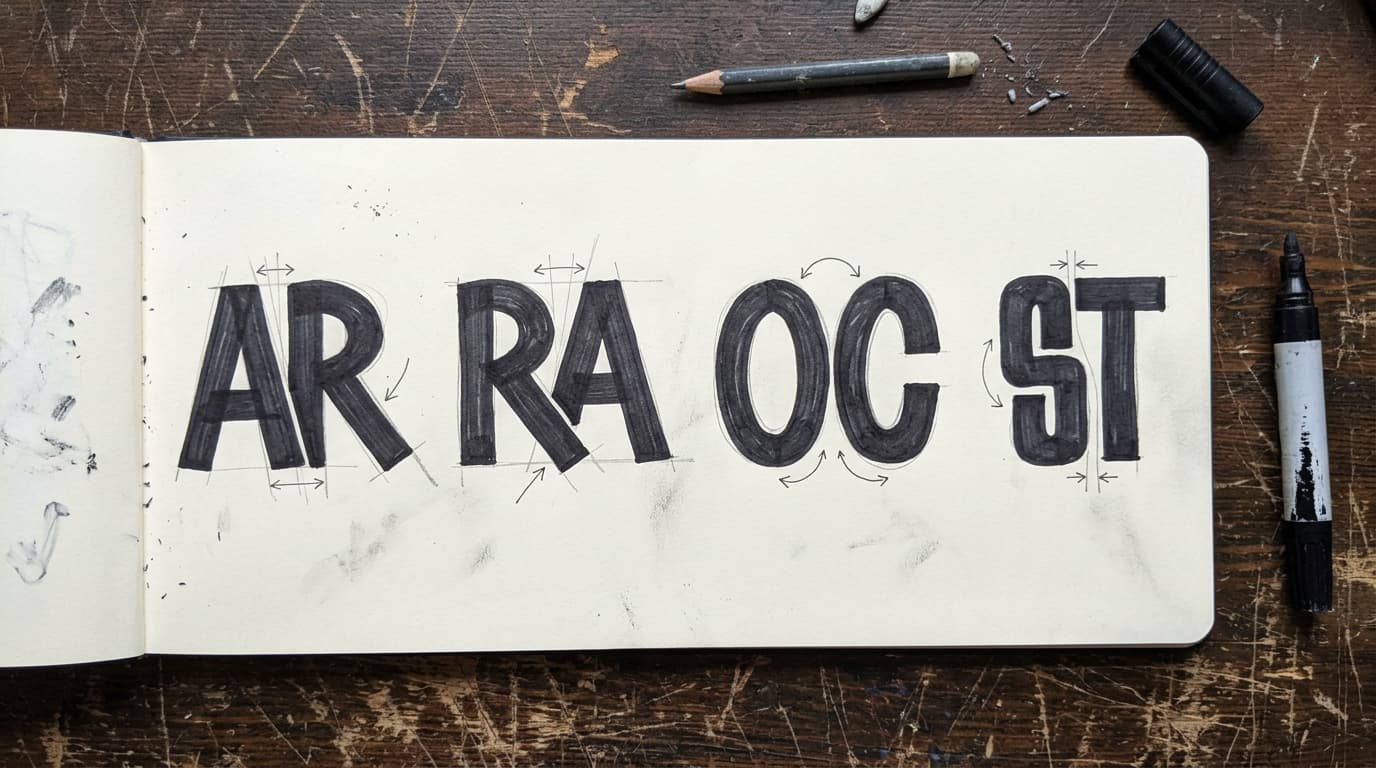
Worked drill: AR, RA, OC, and ST each teach a different handoff. You are not trying to make a masterpiece here. You are catching where the spacing, slant, or counter starts lying.
Next Step
Test One Word in Straight Letters
Pick one word from your blackbook, keep it plain, and check whether the middle pairs still breathe before you add shadows, arrows, or color.
Bad combinations are not cursed. They are just expensive.
Some combinations just cost more control. CL, MP, LL, IT, NN, and VA can all work, but they punish lazy structure fast. Narrow letters choke each other. Heavy letters steal counter space from the next form. Repeated stems turn the word into a fence.
The beginner mistake is blaming the name and switching every ten minutes. Sometimes the word really is wrong for your current hand. Fair. But a lot of the time the pair is telling you the exact lesson you keep dodging.
If two letters keep fighting, strip them down until the bars are obvious. Open the counter. Pick one slant. Kill the rescue arrow. A boring corrected pair teaches more than a stylish cover-up.
| Pair | Why it fights you | First fix |
|---|---|---|
| CL | The L stem can make the C feel like it crashed into a wall | Let the C breathe and give the L a lighter foot |
| MP | Two heavy forms back-to-back can crush the P counter | Make the M narrower or give the P more open bowl space |
| LL | Repeated verticals get boring unless the spacing is perfect | Change one terminal, not the whole letter family |
| IT | Two narrow letters can disappear in the middle of a word | Widen the gap slightly and keep the T simple |
| VA | Strong diagonal energy can turn into a shove | Make the A answer the V instead of copying it |
Failure example: when one cramped pair ruins a readable word
CLAMP should be a useful practice word. It has a round opener, a vertical-to-diagonal handoff, and a heavy finish. But this version shows the trap. The L gets skinny. The A leans into it. The M gets greedy. The P counter is basically asking for air.
That is what people mean when they say the letters are fighting each other. The word reads, but it does not feel settled. Every pair is asking for space and nobody gives any back.
I would not fix this by making it wilder. I would redraw only CL and MP on a separate page. CL needs the L to stand without becoming a toothpick. MP needs the M to lose some weight so the P can open. Then I would put the full word back together with a lighter middle.
- Do not widen every letter at once; fix the pair that actually failed
- Give the P counter air before touching the outline
- Make the A answer the L instead of leaning on top of it
- If the pair only works after a shadow, the handoff is still weak
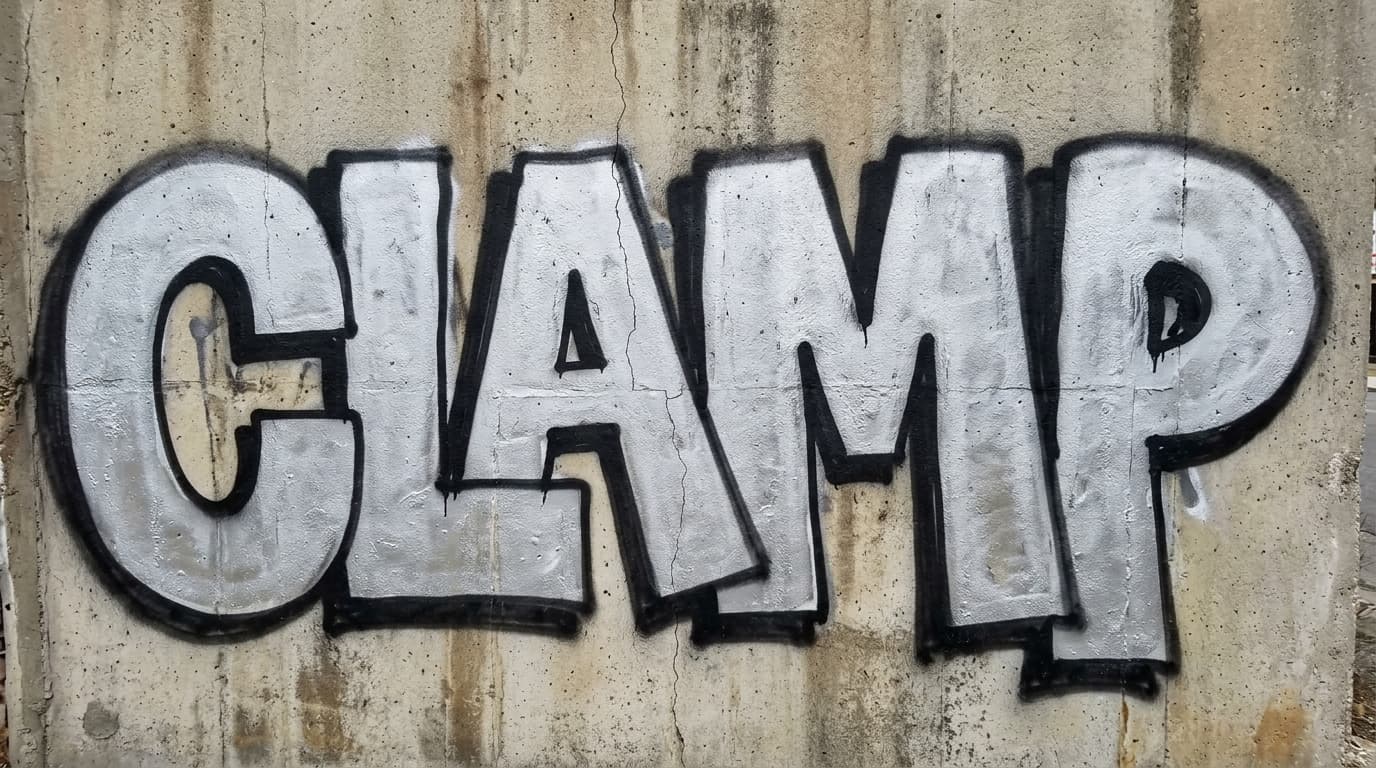
Failure example: readable, but not healthy. The L-A join pinches, the M gets too heavy, and the P counter chokes because the word never agreed on weight or air.
Words that give you useful combinations without turning into homework
A practice word should give you a few honest joins, not punish you for existing. These have enough contrast to teach flow without putting every letter on hard mode.
Do not pick all of them. Pick three. One easy, one awkward, one that keeps beating you in the same spot. That third word is probably the one worth keeping for the week.
- BRACE: B-R weight, R-A diagonal handoff, A-C air, calm C-E finish.
- AERON: open A-E start, round middle, firm N exit. Good if your spacing drifts soft.
- CLOAK: CL pressure, O-A breathing room, K finish. Good if verticals keep disappearing.
- VORTE: V-O contrast, R-T structure, quiet E finish. Good for slant discipline.
- SARK: S-A flow with a sharp RK ending. Good if your exits get too polite.
- MORAL: M-O weight control with a softer AL close. Good for heavy-to-round balance.
- TRACE: T-R structure, A-C air, E finish discipline. Good for clean straight-letter reps.
- UNER: U-N straight control with E-R exit movement. Weird enough to expose lazy habits.
The same pair changes when the style changes
A pair that feels clean in straight letters can get strange in a tag. A pair that flows in handstyle can clog in a throw-up because the fat outline eats the gap. That is not a contradiction. That is tool logic.
In a tag, the question is line rhythm: can your hand move through the pair without stuttering? In a throw-up, the question is mass: can two inflated forms stay separate enough to read? In a piece, the question is structure: can the bars bend without losing the letter?
Paper lets you test the join cheaply. The wall tells you whether your spacing survives real paint. Spray bloom is rude like that. It fattens the edge and exposes every fake gap.
- Tag/handstyle: watch stroke order, speed, and whether the exit belongs to the next letter.
- Throw-up: watch inflated counters and whether two fat letters become one lump.
- Straight letters: watch shared cap height, bar weight, and baseline discipline.
- Wildstyle: watch structure first; complexity is only useful when the pair still reads underneath.
What I would drill tonight
If you want the fastest improvement, do not start with a new style. Start with one ugly join. I would take BRACE, CLAMP, and TRACE and run only the middle pairs: RA, LA, MP, AC.
Ten reps each. Plain bars. No fills. No shadows. Put a tiny mark under the rep where the pair finally stops fighting. Then do one full-word pass after that, not before.
That is enough to make tomorrow's sketch cleaner without pretending you discovered a whole new identity overnight.
The keeper is not the prettiest single letter. The keeper is the word where every letter gives the next one enough room to do its job.
FAQ
What are the best graffiti letter combinations for beginners?
Why do my graffiti letters look good alone but bad in a word?
Should I avoid hard letter pairs like MP, CL, or LL?
Related Reads and Next Actions
Next Step
Ready to Apply This in a Real Generation?
Run one plain word and judge the joins before the style. If the middle pair works clean, the piece has somewhere to go. If it already feels jammed, do not rescue it with effects. Fix the handoff first.